Why roadmaps are useful
Roadmaps are cool:
We use them to plan our business activities
Every teammate knows where we’re heading to
It manifests the vision of the company
When you think about it, all our efforts are destination maps with A and B points. Point B is our goal, while point A is our current benchmark.
The map gets more detailed when you figure out ways to reach B. You discover that B requires going through X and Y first. All while X and Y have their own roads.
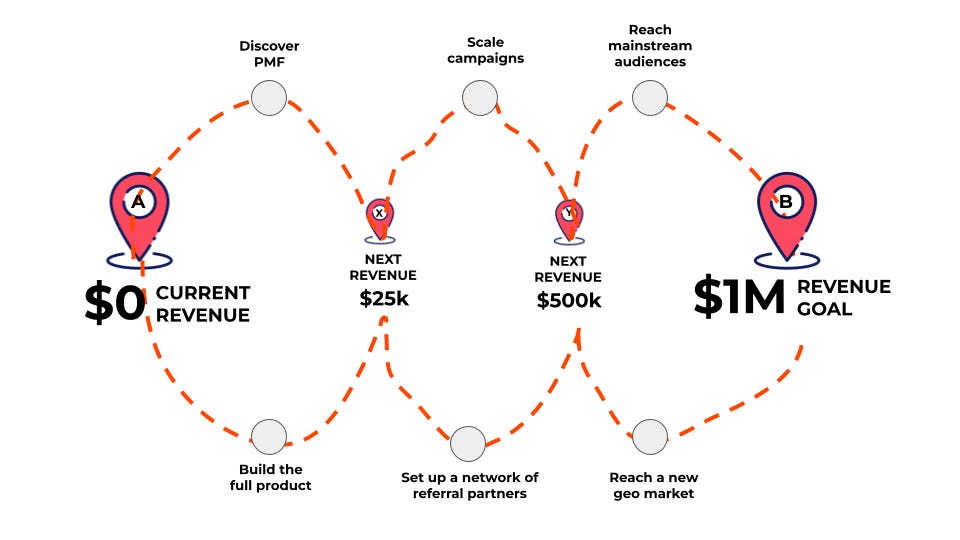
On the destination map, there are several roads to reach B. Some are easier or more rewarding than others. When you identify the most optimal route to B, the map narrows into a roadmap:
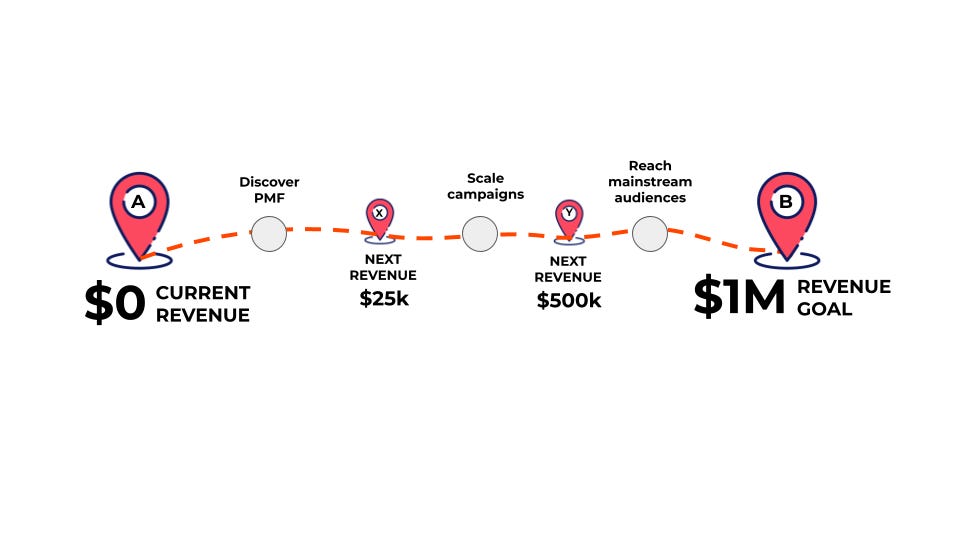
A roadmap helps a company lock in on the target goal. It removes chaotic ideas by asking, “will it help us reach our roadmap goals?”. This saves time on more important ideas.
For investors, roadmaps assure 2 things :
The founders know where they are heading to
The investors can see the full potential of a startup
That last bit actually plays with our mindset vulnerabilities.
Why roadmaps are faulty
Roadmaps exploit our wishful thinking. Showing a linear progress timeline implies that each pitstop point turns out successful. Realistically, each roadmap goal depends on the success of the previous goals.
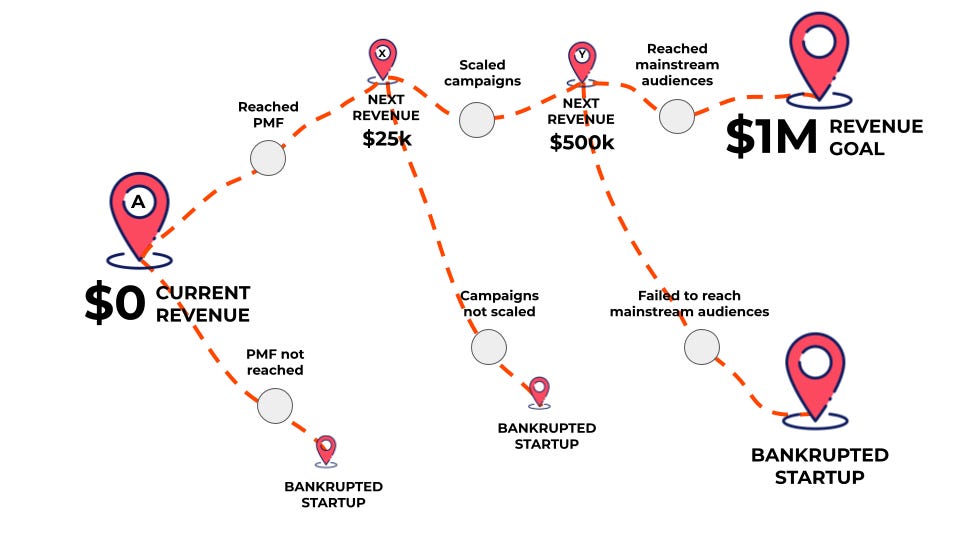
The roadmap concept is not aligned with agile planning. It doesn’t account for unexpected forces that make the goal irrelevant. Typically, roadmaps go 1 year and beyond, which is highly unusual for startup planning.
Roadmaps are especially susceptible to the planning fallacy. Underestimating the odds of successful plan execution leads to unreal expectations. This optimistic vision promises that each roadmap point will be accomplished without setbacks.
Roadmaps fixate on a single path to achieve the goal. If the path is faulty, sticking to it is similar to being a dogmatic believer. Startups are not meant to execute the original vision. They are meant to reach a product-market fit (PMF) adjacent to the original vision. This means ditching a roadmap when it doesn’t show any sign of the PMF.
Roadmap alternative – code of conduct
Don’t criticize without a suggestion!
Instead of roadmaps, I propose to use Code of conduct, for lack of a better word.
Code of conduct is a set of principles for guiding business decisions. Instead of polishing the roadmap, improve the logic behind it. With code of conduct, you enlarge the destination map to ask better questions than “what will we be doing”?
The right questions would be:
“Are we sure that’s where point B is”?
“Are we sure that’s the right road to point B”?
“Are we sure the current road to point B is the best one”?
By doubting your current decisions, you force to match your decision logic with the code of conduct.
Code of conduct is like an algorithm with “if” and “then” logic rules. The growth models inspired by Lean Startup follow a self-improving algorithm:
Research hypotheses
Test hypotheses with metric goals
If successful – scale
Otherwise – repeat step 1
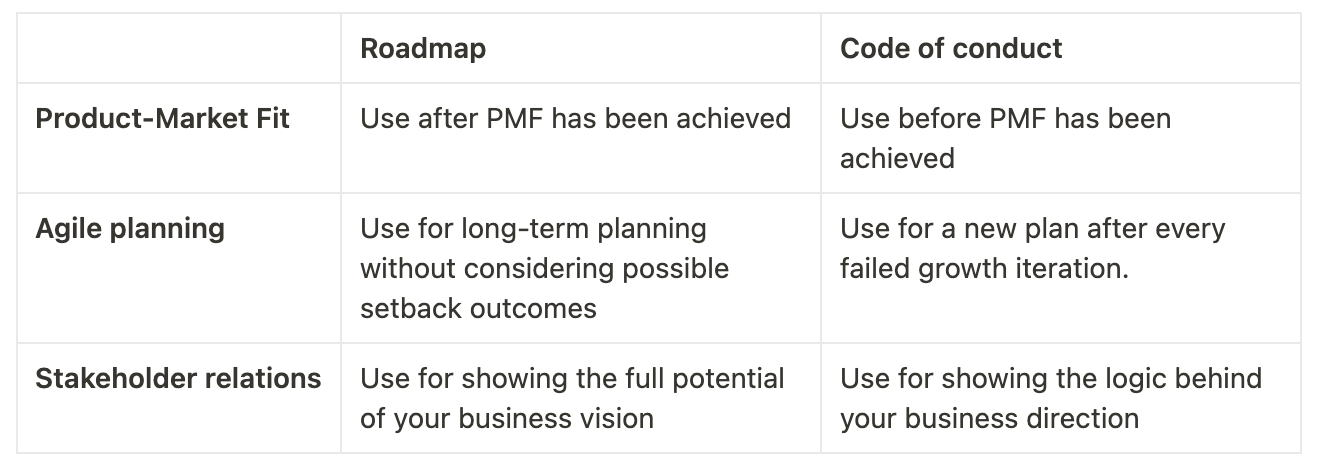
Roadmap vs Code of сonduct