Want your AI to talk to your customers? Make it pass the Turing test first.
Proud builders, uneasy customers
When I applied for a job, I received a video back. A woman who looked completely human looked into the camera and said she was my AI hiring assistant and would guide me through the hiring process.
My first thought was that this felt soulless.
Then I tried to imagine the team that built her. If I worked at a startup creating AI avatars, I would probably think it was a cool thing too. Everyone on that team would feel they were on a mission to bring value. Everyone on the outside sees a face with nobody behind it.
I wonder how many companies are in this spot. AI sales reps, AI recruiters, AI marketers: any client-facing role that used to be a person is getting a synthetic face. The builders celebrate it, and the people who interact with it feel the soullessness.
It reminded me of a video I saw where a guy sent his own AI hiring companion to an interview, and another AI hosted the interview. The result was chaotic, confusing and not productive at all. Two interfaces with nobody behind them were talking to each other, and that is the feeling my video gave me. It is why it felt soulless.
We expect AI to behave like a human
AI content labels already exist, and the label was not what bothered me. We humanize AI so much that we expect it to match human communication, and it does not react like a human in a natural conversation yet. If I want human-like guidance through a hiring process, I would rather watch a clip of a real human than an AI in an interface that looks like a live video call.
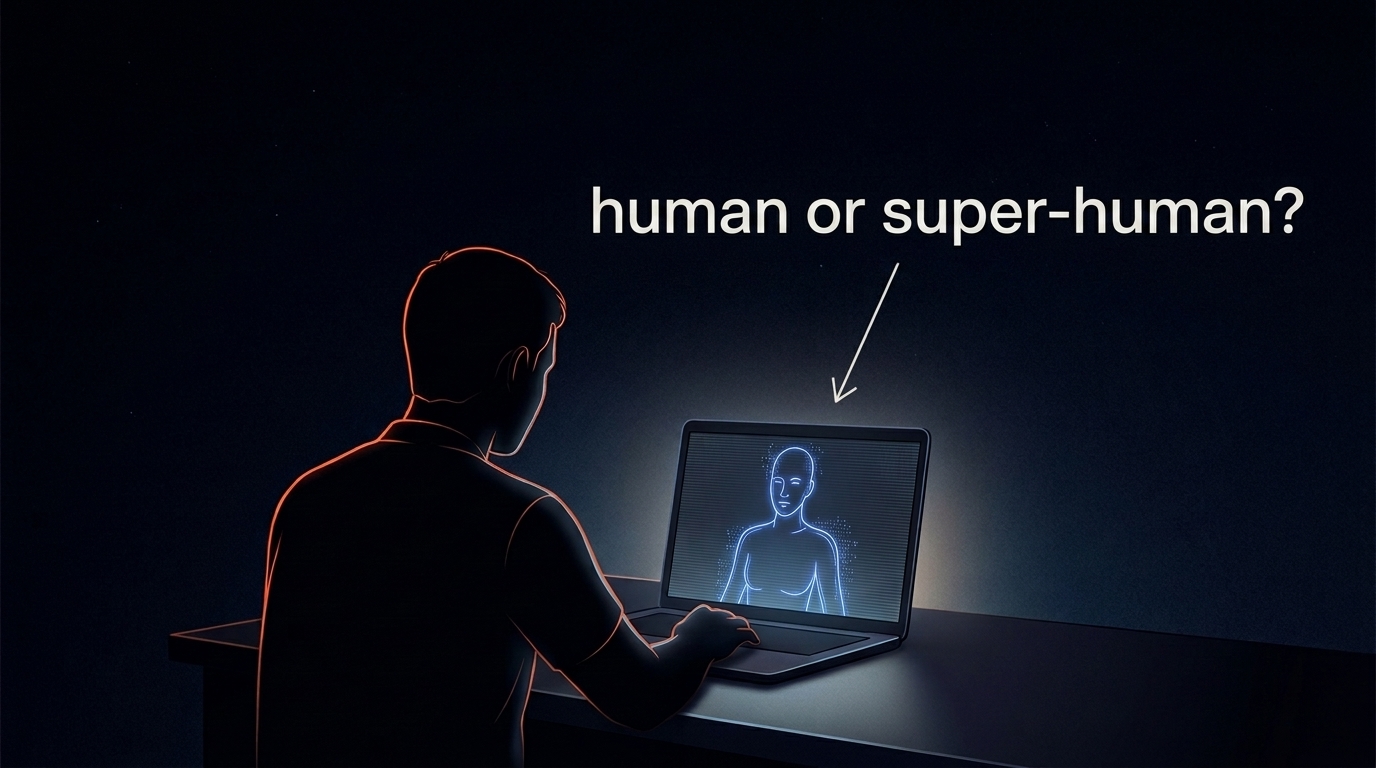
Laws like the EU AI Act require you to tell users when an AI is talking to them. Nobody is asking you to hide it. My point is that once you put an AI in front of people, it still has to act like a human, even with the AI label on it. In a sense, we are making superhumans out of AI. It needs empathy and soft skills, not only correct answers.
That is a high bar, so flesh it out and polish it before it faces your customers. Otherwise your customer experience becomes a a laughing stock for the internet, a counterpoint to the AI hype.
The balance keeps tilting toward AI. Soon it will be silly to assume a very realistic video is real unless a close friend sent it. At some point, Apple or Google will probably push a product that lets you build a bot to talk to your friends, using your conversations and posts to copy your style. Then we would be isolated and talking to humanless interfaces, even better.
I have the same dilemma with this article. I recorded a monologue of about 40 minutes before going to sleep, and I used AI as a translator and editor to structure my thoughts. The raw monologue would not interest a reader, and the structured version might. That is AI in the back end: the thoughts are mine, and the machine helped with the order. Still, I notice that we are becoming dependent on AI for relaying our own perspective.
We all have the same copywriter now
I was talking to the founder of a marketing agency about how Claude builds websites for us, and I remarked that we effectively have the same developer. The LinkedIn feed feels the same way, as if one copywriter writes it for everybody.
I go through my feed, and every second or third post looks AI-written.
We are becoming a hive mind where uniqueness gives way to standardized information. We optimize for grammar until correct grammar is mundane and nobody notices it. You could even argue that using AI to structure information lowers its power to grab attention.
Marketers ran into this before AI. Correction emails with "Oops" in the subject line generally get higher open rates than regular sends, so some marketers started faking the mistake. A slip tells the reader a person wrote it. I also see typos used as a creative style in ad banners.
So if you want to stand out on social media, I think you have to either keep AI out of your editing or over-optimize in the opposite direction, toward spontaneous, chaotic communication. When a reader spots the usual AI writing in a good thought, they assume a short prompt produced it and stop reading. Language might even adapt, with people writing errors on purpose so they don't sound like AI.
If AI has to face your customers
If you run a business, this is the practical part. AI works best in the back end of your communication. Let it sort, draft, structure and search for you, and let it edit minor bits of your text. A person who actually read the message should be the one who answers it.
If you still want an AI that talks to your users directly, you have to be absolutely sure it acts like a human, and that holds even with an AI label on it. Its empathy and soft skills have to work in a natural conversation. The hiring video I received failed that test.
To check, test the communication workflow yourself first. Then give it to a sample of your friends and close ones as a Turing test. If around 80% of them believe they are talking to a human, you can probably use that workflow.
Try it this week: look at the first thing a customer meets in your business and check whether a person is there.
Looking for a technical marketer for your B2B business?
Consider this guy
Comments
Join the discussionNo comments yet. Be the first to comment.