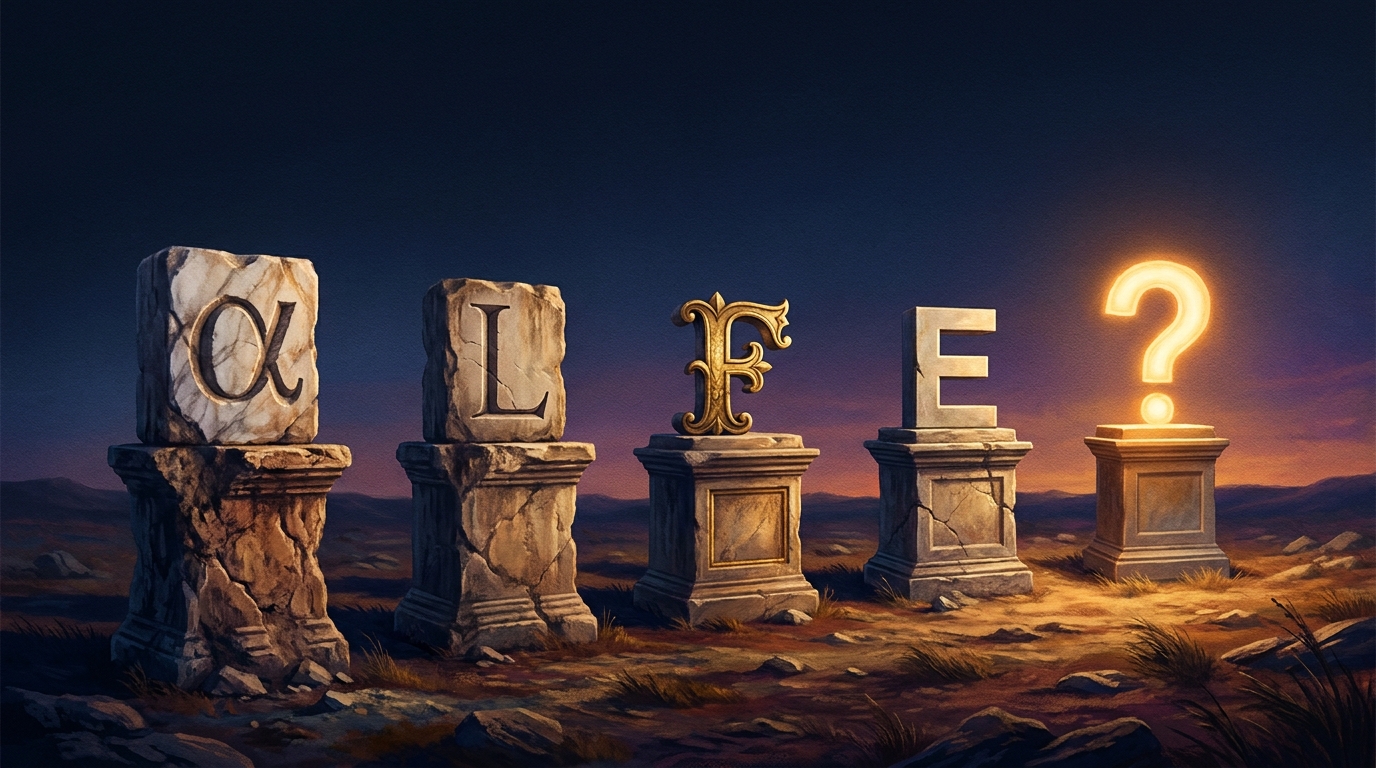
Greek -> Latin -> French -> English -> ???
English was not always the world's main language, and it may not stay one. Each historical period had its own dominant language, and each one gave way when the power behind it shifted.
A non-business article??
Yup, a section for those wondering why I am posting about non-business stuff in what looks to be a business blog. There's so much to the world apart from commerce that I feel like we can draw inspiration from history, politics, art, and science. And so I hope that those articles will serve as an aha moment for business owners.
Languages follow power
The dominant language of any era belongs to whoever holds the armies, the treasury, and the universities. Linguists call it a lingua franca: the tongue that elites, diplomats, and merchants use when they share no mother language.
Greek filled that role after Alexander the Great conquered the eastern Mediterranean and Persia.
Latin replaced it as Rome's empire grew. It began as the speech of the Latini, a tribe in Latium, and after Rome fell it drifted apart region by region into Italian, French, Spanish, Portuguese, Romanian, and the other Romance languages.
In the 1600s and 1700s, French became the language of European courts and treaties. English took over in the 19th and 20th centuries, first through British imperial rule and industrialization, then through American economic and cultural reach.
English holds the position today because of historical momentum. Nothing in its grammar or vocabulary makes it better suited to the job, so a successor may replace it the way it replaced French.
Why 'inquire' sounds smarter than 'ask'
Ask and inquire, help and assist, start and commence mean the same thing, yet the second word in each pair sounds more educated. The second words in these pairs are translations from French: inquire from enquérir, assist from assister, commence from commencer. After the Norman Conquest of 1066, England's rulers spoke French. Common people kept the Germanic words, and the ruling class used the French and Latin ones.
English speakers who wanted to sound educated adopted the French-derived synonyms because French carried the prestige of the elite. Over time those forms came to sound refined.
The same thing happens today in the other direction. Japanese and Korean borrow English words directly, writing them in their own scripts, and the loanwords often sit beside native terms with a more modern or prestigious feel. The dominant language of the era supplies the words that sound current.
Half the world's languages could be dead or dying by 2100
A language dies when parents stop teaching it to their children. The remaining speakers grow old, and when the last one dies, the language goes with them.
The usual driver is language shift: speakers move to a language that carries more economic or social power. War, disaster, and disease kill speakers. States restrict minority languages in schools and media. Marginalization pushes people to drop their language for one that helps them get jobs and acceptance. Cities and mixed-language marriages push children toward the local lingua franca.
Some linguists estimate that 50% to 90% of all languages will be severely endangered or dead by 2100.
Will Mandarin take English's place?
China's rise is real, and its engineers excel at applying and scaling new technology. A strong economy alone does not replace a lingua franca. Mandarin would need China to lead in economy, science, culture, and international institutions at the same time, for several generations.
Mandarin faces four barriers:
- Writing system. Characters and tones make the language hard for non-native learners.
- Reach. Mandarin has spread very little outside East Asia.
- Entrenchment. English dominates academia, science, and global business.
- Soft power. English-language media, universities, and tech companies keep drawing in new learners.
Mandarin may become a global language, but not overnight.
Someone already tried to skip the line
Esperanto is the best-known attempt to build a global language by design. L. L. Zamenhof published its first grammar in 1887 as a neutral second language to ease ethnic division, and by 1905 it had held its first World Congress.
Politics then stalled it: France banned its teaching after the League of Nations recommended it for schools in the 1920s, Nazi Germany banned it in 1935, and Stalin ended Soviet support in 1937. Today it has somewhere between tens of thousands and 2 million speakers.
Nation states would rather push their own language as the lingua franca than agree on a neutral one.
So which language should you learn?
For an average person, this is a practical question. My parents grew up in the USSR, and they could not know whether studying German or English would pay off. They had to guess. People face the same guess today: English looks like the safe bet, yet Mandarin may prepare some of them better. Nobody can say which language will hold power in thirty years, so my answer is to learn AI prompting both, just in case.
Looking for a technical marketer for your B2B business?
Consider this guy
Comments
Join the discussionNo comments yet. Be the first to comment.